by Cate Pilgrim
This winter, Patrick Henry College in Purcellville, VA, played host to the prolifically published and highly influential Chinese economist Dr. Zhao Xiao, drawing an audience of over one hundred and seventy people.
Assisted by a translator and a Powerpoint presentation, Dr. Zhao discussed the current status of China’s economy and its potential growth in the upcoming decade, concluding that a market economy is stable only in countries with stable moral foundations.
Although a member of the Communist Party and fervent Chinese patriot, Dr. Zhao did not ignore the challenges China faces in the areas of social justice, rampant pollution, and ingrained political corruption. Instead, he called for proactive Bible-based moral and economic reforms to allow his country to become “a nation of integrity and a blessing to the world.”
China’s economic vitality is undeniable. Since 1980, China’s annual GDP growth rate has averaged close to 10 percent, a phenomenon that has never been matched by Western powers. Market analysts forecast China’s potential GDP for 2009 to remain high, and predict that in the next ten years, per capita GDP in China will exceed that in the U.S. by $10,000. In recent decades, China’s subsistence population has dropped from 250 million to 20 million, and Dr. Zhao thinks now is the time for his nation to embrace not Western, but Christian, values.
He noted that while no one overlooks China’s economic explosion, they do overlook the Christian growth. The government estimates the Christian population in China at 20 million, but Dr. Zhao said it was well over 180 million. “The essence of China’s modern transition is not political or economic,” he said. “It is spiritual.”
Citing historical examples and utilizing a formidable eloquence, Dr. Zhao presented economic statistics and predictions mixed with his own Christian philosophy to argue that tomorrow’s China has an unparalleled opportunity to become “a city on a hill” if only Christianity will be allowed into the country as a stabilizing economic and social factor. “For three thousand years, China has been in the “no Cross” category,” Dr. Zhao said. “This time China’s transition can be different – it can be with the Cross.”
If Christianity, like Daoism and Buddhism, is allowed to integrate into the Confucian basis of Chinese culture, it will provide “a broader, deeper, stronger cultural foundation”, said Dr. Zhao. “On this platform, China will reform its modern culture.”
Reforms are needed. “Here, heaven and hell coexist,” Dr. Zhao said, contrasting photos of starving street urchins with their wealthy socialite neighbors. “China needs to incubate a stronger middle class and promote a majority of middle-income families,” he said.
Dr. Zhao came out strong for Non-governmental organizations (NGOs) and Non-political organizations (NPOs), noting the positive role they played in bringing aid to the Chinese victims of last May’s deadly earthquakes. “What Zhao is really interested in is getting the idea of NGOs involved in providing framework [in China],” commented Dr. David Aikman following the lecture. “He understands NGOs need to be part of the process of promoting a society of community and cooperation.”
Dr. Zhao, who personally started the Cypress Leadership Institute to train up Chinese leaders to be “salt and light,” believes that if allowed to flourish, NGO/NPOs will be instrumental in China’s struggles with modern slavery, unemployment, civil conflicts, and rampant immorality.
Following a brief Q & A session after the lecture, Dr. Zhao grinned. “Ten years ago, if I said these things, I would probably get in trouble.” Shortly before making that statement, Dr. Zhao fielded an apologetics question from PHC professor and famous apologist Dr. John W. Montgomery concerning the Chinese philosophy of harmony and Confucius. Dr. Zhao maintained that if Confucius was alive today, he would be a Christian, because God’s Word brings ultimate harmony.
His parting words to his still captivated audience were, “Brothers and Sisters, keep praying for China.”
Tuesday, November 10, 2009

Tuesday, April 7, 2009
News Nuggets - April 3
1. April 3 - The Iowa Supreme Court struck down a 1998 state law limiting marriage to a man and a woman, saying that homosexual individuals have a constitutional state right to marry, even if that right is “unappealing” (page 30 of the decision). Aside from striking down the statute approved by the state legislature, the court also found that sexual orientation was a protected class, although this has never been established by Iowa’s state legislature. Also, the court based its decision on an “intermediate” scrutiny analysis, although it had always required “strict” scrutiny on previous cases of this kind. The ruling makes Iowa the first heartland state to legalize same-sex marriage, and potentially increases Mike Huckabee’s 2012 appeal to disgruntled swing-state Iowan conservatives.
http://publicservice.evendon.net/VarnumEtAl_v_BrienPolkCoIAM.htm
http://www.politico.com/blogs/bensmith/0409/Iowa_court_backs_samesex_marriage.html
2. April 2 – After meeting with the Group of Twenty, where world leaders pledged $1.1 trillion to the International Monetary Fund and other global institutions, President Obama noted that American prestige had diminished under Bush, but America’s participation in the summit would help the U.S. He did not specify how it would benefit the American economy.
http://cbs5.com/national/obama.G20.summit.2.973909.html
3. April 3 - The senior commander of U.S. troops in South Korea, four-star General Walter L. Sharp, has ordered an April 25 “stand down” for all U.S. forces in South Korea due to the increase of sexual assaults, aggravated assaults, and other disorderly conduct by military personnel. Last August a relaxed curfew was put into effect, and Sharp believes it has led to indiscipline; he called the four-hour muster to refocus troops on military standards.
http://www.armytimes.com/news/2009/04/army_korea_crimes_040309w/
http://publicservice.evendon.net/VarnumEtAl_v_BrienPolkCoIAM.htm
http://www.politico.com/blogs/bensmith/0409/Iowa_court_backs_samesex_marriage.html
2. April 2 – After meeting with the Group of Twenty, where world leaders pledged $1.1 trillion to the International Monetary Fund and other global institutions, President Obama noted that American prestige had diminished under Bush, but America’s participation in the summit would help the U.S. He did not specify how it would benefit the American economy.
http://cbs5.com/national/obama.G20.summit.2.973909.html
3. April 3 - The senior commander of U.S. troops in South Korea, four-star General Walter L. Sharp, has ordered an April 25 “stand down” for all U.S. forces in South Korea due to the increase of sexual assaults, aggravated assaults, and other disorderly conduct by military personnel. Last August a relaxed curfew was put into effect, and Sharp believes it has led to indiscipline; he called the four-hour muster to refocus troops on military standards.
http://www.armytimes.com/news/2009/04/army_korea_crimes_040309w/
THE G-20 SUMMIT: GLOBAL PROBLEMS, GLOBAL FIXES
by J. Cate Pilgrim
After meeting with the Group of Twenty (G-20), where world leaders promised to crack down on hedge funds and tax havens, as well as pledging $1.1 trillion (get your mind around this number) to the International Monetary Fund and other global institutions, President Obama noted that American prestige had diminished under Bush. He said America’s participation in the summit would help the U.S. “forge partnerships as opposed to dictating solutions,” especially with the G-20’s Troika colleagues, Brazil and South Korea. He called the G-20 prescriptions the boldest international economic crisis response in history, saying proposed measures would have “a concrete effect” in each nation’s economy, but he could not point to any summit accomplishment that would help Americans beyond general points such as fighting protectionism and making the global economy work together. He did turn down French President Sarkozy’s proposal for a global regulator that would oversee every nation’s companies, as did the rest of G-20 representatives.
An examination of the G-20’s promised trillion dollar global bailout shows it to be much smaller than the U.S.’s $787 billion stimulus package. Although the summit trebled resources available to the International Monetary Fund, upping the amount to $750 billion, as well as creating a new Special Drawing Rights (SDR) allocation of $250 billion, Obama expressed dissatisfaction with the numbers. Multilateral development banks (MDBs) were ensured at least $100 billion of additional lending, and summit leaders promised $250 billion of support for trade finance. Additional resources from IMF gold sales were designated to help the poorest countries, and another $50 billion was offered to support social protection, boost trade and safeguard development in low income countries
Members of the twenty largest economies in the world said they were helping to save $5 trillion dollars worth of jobs which would otherwise have been destroyed. Obama promised America’s strategic and political support to the outcomes of the London summit, promising that America, “will not turn inward. We will not focus on ourselves.”
After meeting with the Group of Twenty (G-20), where world leaders promised to crack down on hedge funds and tax havens, as well as pledging $1.1 trillion (get your mind around this number) to the International Monetary Fund and other global institutions, President Obama noted that American prestige had diminished under Bush. He said America’s participation in the summit would help the U.S. “forge partnerships as opposed to dictating solutions,” especially with the G-20’s Troika colleagues, Brazil and South Korea. He called the G-20 prescriptions the boldest international economic crisis response in history, saying proposed measures would have “a concrete effect” in each nation’s economy, but he could not point to any summit accomplishment that would help Americans beyond general points such as fighting protectionism and making the global economy work together. He did turn down French President Sarkozy’s proposal for a global regulator that would oversee every nation’s companies, as did the rest of G-20 representatives.
An examination of the G-20’s promised trillion dollar global bailout shows it to be much smaller than the U.S.’s $787 billion stimulus package. Although the summit trebled resources available to the International Monetary Fund, upping the amount to $750 billion, as well as creating a new Special Drawing Rights (SDR) allocation of $250 billion, Obama expressed dissatisfaction with the numbers. Multilateral development banks (MDBs) were ensured at least $100 billion of additional lending, and summit leaders promised $250 billion of support for trade finance. Additional resources from IMF gold sales were designated to help the poorest countries, and another $50 billion was offered to support social protection, boost trade and safeguard development in low income countries
Members of the twenty largest economies in the world said they were helping to save $5 trillion dollars worth of jobs which would otherwise have been destroyed. Obama promised America’s strategic and political support to the outcomes of the London summit, promising that America, “will not turn inward. We will not focus on ourselves.”
Alzheimer’s Treatments: $1 Trillion. Saving America’s Memory: Priceless
March 25, 2009:
Forget the AIG scandal. Move over, TARP. Demographers estimate the cost of dementia to both Medicare and Medicaid combined will top $20 trillion over the next two score years. Take a look at the report the Alzheimer's Study Group conducted on American’s with Alzheimer’s—their numbers suggest that Alzheimer’s related costs to Medicare and Medicaid alone will top $1 trillion annually by 2050. The report says that in 2008, Alzheimer’s replaced diabetes as the 6th leading cause of death in the U.S., with 100,000 more cases diagnosed than in 2007. Currently, there are 9.9 million unpaid caregivers providing adult day care to Alzheimer’s victims, with twice that many involved in treating them.
In 2004, the Medicare cost per dementia patient over 65 was $33,007, and the cost is rising. In 2005 alone, Medicare expenditures for Alzheimer's exceeded $90 billion. Every 70 seconds an American develops Alzheimer's disease, and there are an estimated 5.1 million Americans over 65 battling the disease. By 2031, as the Baby Boomer generation ages, an estimated 3.5 million people will have Alzheimer's.
This week, Maria Shriver, former Supreme Court Justice Sandra Day O'Connor, former Senator Bob Kerry and Newt Gingrich all testified on Capitol Hill on the effects of Alzheimer’s, urging the U.S. to step up research into the currently-incurable malady. Citing the success federally underwritten AIDS research has had (for $10 billion research dollars, over $1.4 trillion in AIDS treatment costs were averted, according to the National Institutes of Health), Newt Gingrich strongly advocated a new fiscal model for government support of Alzheimer's inquiry, one that would measure public investment against public savings.
Forget the AIG scandal. Move over, TARP. Demographers estimate the cost of dementia to both Medicare and Medicaid combined will top $20 trillion over the next two score years. Take a look at the report the Alzheimer's Study Group conducted on American’s with Alzheimer’s—their numbers suggest that Alzheimer’s related costs to Medicare and Medicaid alone will top $1 trillion annually by 2050. The report says that in 2008, Alzheimer’s replaced diabetes as the 6th leading cause of death in the U.S., with 100,000 more cases diagnosed than in 2007. Currently, there are 9.9 million unpaid caregivers providing adult day care to Alzheimer’s victims, with twice that many involved in treating them.
In 2004, the Medicare cost per dementia patient over 65 was $33,007, and the cost is rising. In 2005 alone, Medicare expenditures for Alzheimer's exceeded $90 billion. Every 70 seconds an American develops Alzheimer's disease, and there are an estimated 5.1 million Americans over 65 battling the disease. By 2031, as the Baby Boomer generation ages, an estimated 3.5 million people will have Alzheimer's.
This week, Maria Shriver, former Supreme Court Justice Sandra Day O'Connor, former Senator Bob Kerry and Newt Gingrich all testified on Capitol Hill on the effects of Alzheimer’s, urging the U.S. to step up research into the currently-incurable malady. Citing the success federally underwritten AIDS research has had (for $10 billion research dollars, over $1.4 trillion in AIDS treatment costs were averted, according to the National Institutes of Health), Newt Gingrich strongly advocated a new fiscal model for government support of Alzheimer's inquiry, one that would measure public investment against public savings.
Monday, March 16, 2009
GOVERNOR VS. STATE
Obama’s nomination of Kansas Gov. Kathleen Sebelius (D) for Secretary of Health and Human Services isn’t making conservative circles happy, and is causing a big headache for Kansas Attorney General Steve Six. Six is currently prosecuting long-time friend of Sebelius, the late-term-abortionist George Tiller for 19 misdemeanor counts of failing to follow Kansas law in properly obtaining second opinions before performing late term abortions. Many Americans see Tiller as the victim of a relentless witch hunt, instigated by then-Kansas Attorney General Phil Kline, a Republican. In 2006 Kline charged Tiller with illegally performing late-term abortions, and after Tiller got the charges dropped due to a technicality about jurisdiction, Kline was raked over the coals for his “anti-women’s health” politics and labeled “The Snoop Dog” by Democrat Paul Morrison.
Interestingly, Morrison was Sebelius’s personal recruit to run against Kline for the office of attorney general. When pro-choice Kansas voters elected Morrison, who favors abortion, they were not expecting him to continue Kline’s “intrusive” investigation of Tiller’s methods, yet in 2007 Morrison himself brought charges against Tiller for repeatedly violating a technical aspect of the 1998 Kansas late-term abortion law. Unfortunately, before Tiller could come to trial, Morrison was accused of sexual harassment by a female subordinate with whom he had had a two-year extramarital affair, and resigned in 2008, forcing Sebelius to find a new democrat, Steve Six, who is reportedly “not excited” about inheriting the trial of “Tiller the Killer.”
Conservatives are not excited about Sebelius’s track record in public office. In 2007 the state of Kansas was both prosecuting Tiller as a criminal, and honoring him as a hero when Sebelius hosted an April banquet in honor of Tiller, 25 friends and abortion clinic employees, and Nebraska partial-birth abortionist LeRoy Carhart at the Governor's mansion (a party which she only ended up paying for after a pro-life group proved it had been thrown at taxpayer expense).
Sebelius, a practicing Catholic, is taking flak for her support of and friendship with the Kansas-based Tiller, who has contributed at least $38,000 to her political campaigns.
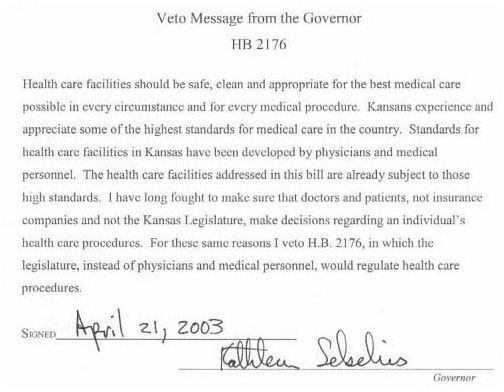
Additionally, Gov. Sebelius spots a solid pro-abortion-rights record dating back to her days in the Kansas House of Representatives when she commented, "I think for me and a lot of other people, there are certain inalienable rights established for a person, but those are not applied in utero." As governor, Sebelius reduced state funding for abortion alternatives, vetoed a bill imposing minimal sanitary standards in abortion clinics, and vetoed a bill (which enjoyed a two-thirds majority in both the Kansas House and Senate) strengthening Kansas's parental notification law. She also vetoed a measure requiring explicit medical reasons for late-term abortions, and vetoed a similar measure making abortion providers file a report on diagnoses necessitating post-viability abortions.
These controversial issues have gone virtually unreported by mainstream media. The NY Times hasn't mentioned Sebelius/Tiller other than an editorial lauding Tiller as a women's rights champion. Associated Press left out Sebelius in its story on Tiller in which it referred to his current trial (opening arguments begin March 23) as a "witch hunt." Mute on the evidence that Tiller had a suspect financial relationship with the "independent" doctor providing second opinions on the validity of Tiller's late term abortions.
The question is whether Sebelius will attempt to distance herself from Tiller. Her own archbishop, Joseph Naumann, opposes her appointment to the HHR position, and has recommended that she not present herself for communion. However, progressive Catholic organizations like Catholics United, defend Sebelius on the basis of declining abortion rates in Kansas; numbers based on unreliable and unclear research according to Dr. New of the University of Alabama.
Is there any chance of Obama distancing himself from Sebelius? No date for her Senate hearings has been set, but Catholic League president Bill Donahue noted upon Sebelius' nomination that almost every Obama appointee is pro-abortion. He suggests that her confirmation would create "a battle between those Catholics who are honestly pro-life, and those who feign a pro-life position while always embracing the likes of Sebelius."
Interestingly, Morrison was Sebelius’s personal recruit to run against Kline for the office of attorney general. When pro-choice Kansas voters elected Morrison, who favors abortion, they were not expecting him to continue Kline’s “intrusive” investigation of Tiller’s methods, yet in 2007 Morrison himself brought charges against Tiller for repeatedly violating a technical aspect of the 1998 Kansas late-term abortion law. Unfortunately, before Tiller could come to trial, Morrison was accused of sexual harassment by a female subordinate with whom he had had a two-year extramarital affair, and resigned in 2008, forcing Sebelius to find a new democrat, Steve Six, who is reportedly “not excited” about inheriting the trial of “Tiller the Killer.”
Conservatives are not excited about Sebelius’s track record in public office. In 2007 the state of Kansas was both prosecuting Tiller as a criminal, and honoring him as a hero when Sebelius hosted an April banquet in honor of Tiller, 25 friends and abortion clinic employees, and Nebraska partial-birth abortionist LeRoy Carhart at the Governor's mansion (a party which she only ended up paying for after a pro-life group proved it had been thrown at taxpayer expense).
Sebelius, a practicing Catholic, is taking flak for her support of and friendship with the Kansas-based Tiller, who has contributed at least $38,000 to her political campaigns.
Additionally, Gov. Sebelius spots a solid pro-abortion-rights record dating back to her days in the Kansas House of Representatives when she commented, "I think for me and a lot of other people, there are certain inalienable rights established for a person, but those are not applied in utero." As governor, Sebelius reduced state funding for abortion alternatives, vetoed a bill imposing minimal sanitary standards in abortion clinics, and vetoed a bill (which enjoyed a two-thirds majority in both the Kansas House and Senate) strengthening Kansas's parental notification law. She also vetoed a measure requiring explicit medical reasons for late-term abortions, and vetoed a similar measure making abortion providers file a report on diagnoses necessitating post-viability abortions.
These controversial issues have gone virtually unreported by mainstream media. The NY Times hasn't mentioned Sebelius/Tiller other than an editorial lauding Tiller as a women's rights champion. Associated Press left out Sebelius in its story on Tiller in which it referred to his current trial (opening arguments begin March 23) as a "witch hunt." Mute on the evidence that Tiller had a suspect financial relationship with the "independent" doctor providing second opinions on the validity of Tiller's late term abortions.
The question is whether Sebelius will attempt to distance herself from Tiller. Her own archbishop, Joseph Naumann, opposes her appointment to the HHR position, and has recommended that she not present herself for communion. However, progressive Catholic organizations like Catholics United, defend Sebelius on the basis of declining abortion rates in Kansas; numbers based on unreliable and unclear research according to Dr. New of the University of Alabama.
Is there any chance of Obama distancing himself from Sebelius? No date for her Senate hearings has been set, but Catholic League president Bill Donahue noted upon Sebelius' nomination that almost every Obama appointee is pro-abortion. He suggests that her confirmation would create "a battle between those Catholics who are honestly pro-life, and those who feign a pro-life position while always embracing the likes of Sebelius."
Wednesday, March 11, 2009
Charity: Don't Begin at Home
Even though America is home to over 1.6 million tax-exempt organizations which account for nearly a tenth of the U.S. economy and are primarily funded by wealthy people, Obama's new budget plans on limiting the charitable deduction for the wealthy. The move, which conservatives see as an unprecedented intrusion into the private sector, has discomfited nonprofits across the country. The budget slashes the tax deduction those earning more than $250,000 can take for their charitable giving, dropping it from 33-35% to around 28%.
Obama’s budget director, Peter Orszag, says by limiting itemized deductions, $634 billion would be available to fund health care reform. He argues that although the top income tax deduction for charitable contributions was reduced from 38.6 percent to 35 percent between 2002-2003, individual charitable contributions rose. Yet in a study released earlier this week, the Center on Philanthropy at Indiana University shows that charitable giving is sensitive to the after-tax incomes of high-income households.
The study shows that if the provision had been in place in 2006, charities would have lost almost $4 billion in donations in the intervening period. Independent Sector reports that 89% of American households contribute to charity, with an average contribution of $1,620, which comes out to 3.1% of their income. Additional IRS statistics reveal that the average taxpayer with AGI over $200,000 makes over $20,000 of charitable contributions.
Twenty-four hours after the Presidents FY 2010 budget hit the press, Orzag attempted to reassure ruffled nonprofits. He posted on his Office of Management and Budget blog that the tax change wouldn’t be imposed until 2011, when “we expect the economy to be recovering…from the recession we inherited.”
Conservatives feel that they’re being blamed for the economic mess, and they fear that successful American families will bear the brunt of the government’s implementation of “positive change.” It appears that the proposed limitations on charitable giving is the government’s way of cutting out the individual from social change—getting rid of the Citizen Middleman. Then the government can choose which programs to fund to “help” society. Right now, the American tax payer gets to decide whether their charitable dollars will aid the poor or build new facilities for colleges; depending on their personal information on which would be more effective or necessary. The theory is: People make better choices than bureaucracies and have more freedom to be generous.
Perhaps the connection problem between the Obama administration and charitable giving is that there isn’t one.
During last year’s campaign, Bill Burton, a campaign spokesman, defended the Obamas scanty charitable donations, saying they gave as much as they could afford. Barack and Michelle gave less than one percent of their $1.2 million income from 2000 to 2004. The Biden’s tax returns show that the Bidens have been amazingly tight-fisted as well. Despite income ranging from $210,432 - $321,379 over a ten-year period, the Bidens have given only $120 - $995 per year to charity, which amounts to 0.06% - 0.31% of their income. Compare that to John McCain, whose tax returns show that he gave 27.3% - 28.6% of his income to charity in 2006-2007. Not that Biden’s charitable contributions haven’t increased. They suddenly spiked in 2007 —which would be just about the time he decided that the White House was within reach. Unfortunately, Biden must have forgotten all the flak Vice President Al Gore took when America found out about his whopping $353 in charitable contributions one year.
Although President Obama is counting on the charitable tax change provision to raise $179.8 billion over 10 years for government spending, Roberton Williams, senior fellow at the Tax Policy Center, predicts organizations dependent on philanthropic giving will have to pay the price.
Obama’s budget director, Peter Orszag, says by limiting itemized deductions, $634 billion would be available to fund health care reform. He argues that although the top income tax deduction for charitable contributions was reduced from 38.6 percent to 35 percent between 2002-2003, individual charitable contributions rose. Yet in a study released earlier this week, the Center on Philanthropy at Indiana University shows that charitable giving is sensitive to the after-tax incomes of high-income households.
The study shows that if the provision had been in place in 2006, charities would have lost almost $4 billion in donations in the intervening period. Independent Sector reports that 89% of American households contribute to charity, with an average contribution of $1,620, which comes out to 3.1% of their income. Additional IRS statistics reveal that the average taxpayer with AGI over $200,000 makes over $20,000 of charitable contributions.
Twenty-four hours after the Presidents FY 2010 budget hit the press, Orzag attempted to reassure ruffled nonprofits. He posted on his Office of Management and Budget blog that the tax change wouldn’t be imposed until 2011, when “we expect the economy to be recovering…from the recession we inherited.”
Conservatives feel that they’re being blamed for the economic mess, and they fear that successful American families will bear the brunt of the government’s implementation of “positive change.” It appears that the proposed limitations on charitable giving is the government’s way of cutting out the individual from social change—getting rid of the Citizen Middleman. Then the government can choose which programs to fund to “help” society. Right now, the American tax payer gets to decide whether their charitable dollars will aid the poor or build new facilities for colleges; depending on their personal information on which would be more effective or necessary. The theory is: People make better choices than bureaucracies and have more freedom to be generous.
Perhaps the connection problem between the Obama administration and charitable giving is that there isn’t one.
During last year’s campaign, Bill Burton, a campaign spokesman, defended the Obamas scanty charitable donations, saying they gave as much as they could afford. Barack and Michelle gave less than one percent of their $1.2 million income from 2000 to 2004. The Biden’s tax returns show that the Bidens have been amazingly tight-fisted as well. Despite income ranging from $210,432 - $321,379 over a ten-year period, the Bidens have given only $120 - $995 per year to charity, which amounts to 0.06% - 0.31% of their income. Compare that to John McCain, whose tax returns show that he gave 27.3% - 28.6% of his income to charity in 2006-2007. Not that Biden’s charitable contributions haven’t increased. They suddenly spiked in 2007 —which would be just about the time he decided that the White House was within reach. Unfortunately, Biden must have forgotten all the flak Vice President Al Gore took when America found out about his whopping $353 in charitable contributions one year.
Although President Obama is counting on the charitable tax change provision to raise $179.8 billion over 10 years for government spending, Roberton Williams, senior fellow at the Tax Policy Center, predicts organizations dependent on philanthropic giving will have to pay the price.
Sunday, March 1, 2009
The U.S. shares more than a 1952-mile border with Mexico
Not long after the U.S. National Drug Intelligence Center issued its annual drug-threat assessment, in which it warned that “Mexican drug trafficking organizations represent the greatest organized crime threat to the United States,” Justice Department officials arrested 755 members of the powerful and feared Sinaloa Cartel. Agents working on the DEA’s 21-month crackdown (named “Operation Xcellerator”) caught only 20 of the drug operators on Mexican soil. They pulled in the remaining 735 from California, Minnesota and Maryland, and other cities and towns across the U.S. While the arrests are celebrated as a victory against drug cartels, they also highlight U.S. involvement in Mexico’s escalating drug problem and its economic factors.
Mexico’s economy is the 14th-largest in the world and Mexico is the U.S.’s second-largest export market. Since January, the Mexican currency has fallen around 5 percent against the U.S dollar, coming on the heels of a 21-percent slump in 2008. Mexico's central bank reluctantly intervened last October when the peso hit its lowest slump since 1993, but the year outlook is pretty bleak.
Petroleos Mexicanos, the state-owned oil company, said that crude output fell 9.2 percent in 2008, the largest percentage decline since World War II, as production at its biggest field dropped. PeMex provides about one-third of Mexico's federal government revenue. Mexican Finance Minister Augustin Carstens said economic growth in the fourth quarter of last year was “close to zero,” and that the government forecasts no growth this year.
Economic instability foments unrest. Mix in rampant drug activity, violence, and corruption in the government, and you have the recipe for Mexico 2009. Forbes reported both Pakistan and Mexico as nations facing a potential “failed state,” much to the outrage of Mexican President Felipe Calderón.
Calderón vows that before his term ends in 2012 he will have defeated the cartels, but the rising body count is alarming. In 2009 narcotraficantes claimed over 6,000 lives, and that number is expected to be higher this year. On a single day this month, a drug gang executed six members of a rival gang on the side of PanAmerican highway across the border from El Paso, Texas. The ensuing gunfights left 21 dead. Gruesome murders and decapitations have become familiar drug-zone terror-tactics. The cartels are trying to scare away law enforcement, and Felipe González González thinks they are doing a good job.
González, president of the Senate public security commission and former governor of the central state of Aguascalientes, sees the inability of government troops to protect its citizens from drug-gangs as a grave problem. González told Forbes “It has been a fierce bloodbath…we have more dead than you have in Iraq.”
President Obama, who faced criticism for not visiting Mexico upon taking office, has yet to address the situation. In a February 2008 op-ed published while he was Senator, Obama said that as president he would repair strained relations through diplomacy and partnership. “Mr. Bush took office vowing to make the Americas a top priority. But over the last seven years, the administration's approach to this issue has been clumsy, disinterested and, above all, distracted by the war in Iraq. Indeed, relations have not fully recovered since Mexico refused to fall in line with President Bush's rush to war.”
Mexico’s economy is the 14th-largest in the world and Mexico is the U.S.’s second-largest export market. Since January, the Mexican currency has fallen around 5 percent against the U.S dollar, coming on the heels of a 21-percent slump in 2008. Mexico's central bank reluctantly intervened last October when the peso hit its lowest slump since 1993, but the year outlook is pretty bleak.
Petroleos Mexicanos, the state-owned oil company, said that crude output fell 9.2 percent in 2008, the largest percentage decline since World War II, as production at its biggest field dropped. PeMex provides about one-third of Mexico's federal government revenue. Mexican Finance Minister Augustin Carstens said economic growth in the fourth quarter of last year was “close to zero,” and that the government forecasts no growth this year.
Economic instability foments unrest. Mix in rampant drug activity, violence, and corruption in the government, and you have the recipe for Mexico 2009. Forbes reported both Pakistan and Mexico as nations facing a potential “failed state,” much to the outrage of Mexican President Felipe Calderón.
Calderón vows that before his term ends in 2012 he will have defeated the cartels, but the rising body count is alarming. In 2009 narcotraficantes claimed over 6,000 lives, and that number is expected to be higher this year. On a single day this month, a drug gang executed six members of a rival gang on the side of PanAmerican highway across the border from El Paso, Texas. The ensuing gunfights left 21 dead. Gruesome murders and decapitations have become familiar drug-zone terror-tactics. The cartels are trying to scare away law enforcement, and Felipe González González thinks they are doing a good job.
González, president of the Senate public security commission and former governor of the central state of Aguascalientes, sees the inability of government troops to protect its citizens from drug-gangs as a grave problem. González told Forbes “It has been a fierce bloodbath…we have more dead than you have in Iraq.”
President Obama, who faced criticism for not visiting Mexico upon taking office, has yet to address the situation. In a February 2008 op-ed published while he was Senator, Obama said that as president he would repair strained relations through diplomacy and partnership. “Mr. Bush took office vowing to make the Americas a top priority. But over the last seven years, the administration's approach to this issue has been clumsy, disinterested and, above all, distracted by the war in Iraq. Indeed, relations have not fully recovered since Mexico refused to fall in line with President Bush's rush to war.”
Saturday, February 14, 2009
Focus on Firewalls
by Cate Pilgrim
Over the next four years, the U.S. government is slated to give $10 billion in cyber security contracts to defense companies like Northrop Grumman and Lockheed Martin. This decision comes in the wake of a break-in to the Federal Aviation Administration where the personnel files of 45,000 FAA workers were compromised, as well as several high-risk hacks to high-profile public sites like Facebook and Twitter.
According to Daily Tech, President Obama has issued a 60-day review of federal cyber security, where the "plans, programs and activities" of U.S. cyber security efforts against both domestic and foreign attacks will be scrutinized and updated.
And cyber security may become an even greater concern as a result of the massive economic stimulus bill. Fast Company reports that the American Recovery and Reinvestment Act has earmarked billions of dollars of funding for the digitization of medical health records, and the construction of a computer-controlled "smart grid" to carry electricity. This digitization could potentially allow hackers to de-power entire states, or regions.
The break-in at the FAA isn't the first major security breach. In June 2008, the Chinese military hacked into the U.S. Defense Secretary’s computer system, and that two hackers working for the People’s Liberation Army (PLA) recently announced their plan to engineer cyber-dominance over the U.S. and other nations.
Despite the $10 billion in defense cyber spending and the 60-day review, at least one talented hacker thinks the Obama administration still isn’t getting it. Consider President Obama’s fierce devotion to his personal blackberry, says Kevin Mitnick.
Ten years ago, Kevin Mitnick was the most wanted computer criminal in U.S. history. He specialized in hacking and wire-tapping major cell phone companies, and after his 1995 arrest, Mitnick spent 8 months of his 4 year sentence in solitary confinement. He's got a reputation as a hacking genius-the best of the best; I heard him described as the Michael Phelps of computer hacking. Since his jumpsuit days, Mitnick has switched to the private sector and now operates as a computer security consultant and author. He's telling Obama not to mess around.
In an interview with FOXNEWS.com , Mitnick said Obama's blackberry presents a global target for hackers of all stripes. "You'd probably need to be pretty sophisticated, but there's people out there who are," Mitnick said. For 21st century America, better firewalls are not optional.
Over the next four years, the U.S. government is slated to give $10 billion in cyber security contracts to defense companies like Northrop Grumman and Lockheed Martin. This decision comes in the wake of a break-in to the Federal Aviation Administration where the personnel files of 45,000 FAA workers were compromised, as well as several high-risk hacks to high-profile public sites like Facebook and Twitter.
According to Daily Tech, President Obama has issued a 60-day review of federal cyber security, where the "plans, programs and activities" of U.S. cyber security efforts against both domestic and foreign attacks will be scrutinized and updated.
And cyber security may become an even greater concern as a result of the massive economic stimulus bill. Fast Company reports that the American Recovery and Reinvestment Act has earmarked billions of dollars of funding for the digitization of medical health records, and the construction of a computer-controlled "smart grid" to carry electricity. This digitization could potentially allow hackers to de-power entire states, or regions.
The break-in at the FAA isn't the first major security breach. In June 2008, the Chinese military hacked into the U.S. Defense Secretary’s computer system, and that two hackers working for the People’s Liberation Army (PLA) recently announced their plan to engineer cyber-dominance over the U.S. and other nations.
Despite the $10 billion in defense cyber spending and the 60-day review, at least one talented hacker thinks the Obama administration still isn’t getting it. Consider President Obama’s fierce devotion to his personal blackberry, says Kevin Mitnick.
Ten years ago, Kevin Mitnick was the most wanted computer criminal in U.S. history. He specialized in hacking and wire-tapping major cell phone companies, and after his 1995 arrest, Mitnick spent 8 months of his 4 year sentence in solitary confinement. He's got a reputation as a hacking genius-the best of the best; I heard him described as the Michael Phelps of computer hacking. Since his jumpsuit days, Mitnick has switched to the private sector and now operates as a computer security consultant and author. He's telling Obama not to mess around.
In an interview with FOXNEWS.com , Mitnick said Obama's blackberry presents a global target for hackers of all stripes. "You'd probably need to be pretty sophisticated, but there's people out there who are," Mitnick said. For 21st century America, better firewalls are not optional.
Saturday, February 7, 2009
Second Thoughts on Second in Command
by Cate Pilgrim
This week President Obama nominated David W. Ogden to be the Deputy Attorney General in the Department of Justice, much to the delight of Playboy, Adam & Eve, and other adult entertainment companies, but maybe not to the rest of the Democratic Party.
You see, back in the Clinton Administration, Ogden defended the rights and interests of the pornography industry before the Supreme Court, with the support of Attorney General Janet Reno but not of President Clinton. It produced what was at the time a very embarrassing set of moments for the Clinton Administration, including a reprimand of Reno and a backlash from conservatives.
The case involved Stephen Knox, a man clearly convicted of federal child pornography offenses. The Knox brief, written by Ogden, stated that the First Amendment protected an individual’s right to pornography, and that it was unconstitutional to label certain material “offensive” through “subjective test of lasciviousness.” Attorney General Reno supported Ogden’s position, stating that the Third Circuit erred by ruling that “simply focusing on the midsection of a clothed body may constitute an exhibition of the unrevealed body parts beneath the garments.” The United States was prosecuting Knox based exclusively on his three video tapes depicting numerous 11 to 17 year old girls engaged in sexually explicit conduct (in violation of 18 U.S.C. § 2252).
In November, 1993, when Clinton was informed of his own Attorney General’s stance on the child-pornography issue, he reprimanded her via a letter as reported by the NY Times. Clinton said he was not satisfied with the department’s approach, and said “I find all forms of child pornography offensive and harmful, as I know you do, and I want the Federal Government to lead aggressively in the attack against the scourge of child pornography.” Concerning the Knox case, over 230 Congressmen voted to deny it review, and Reno subsequently replaced her brief with one suggesting the court deny the case review.
Both Democrats and Conservatives demanded investigation into the proceedings. David E. Smith, who was at the time of the Knox case was representing the American Family Association, remembers holding several press interviews a day. Smith instructed skeptical reporters to view the videos Knox had made of the children, and said the ones who did unanimously agreed it was child pornography.
Is Ogden as DAG, a politician who has never since the Knox case altered his position on child pornography, consistent with President Obama’s platform of “Hope” and “Change?” During his U.S. Senate days, President Obama co-sponsored the “Combating Child Exploitation Act of 2007.” Also, while on the ’08 Campaign trail, then-candidate Obama told America (Saddleback Presidential Forum, 08/16/08)he would make ending human trafficking “a top priority” of his administration; additionally, he said (“The Candidates on Faith,” Time, 08/07/08)that there are a “range of moral-values issues that must be addressed in our families, our communities...But we can't just talk about ‘family values.’ We actually have to stand up for policies that value families.” Does Obama know that Ogden's past clients have included the company PHE, Inc., the largest distributor of hard-core porn videos in the U.S., which has distributed DVDs with titles that include terms such as "School girls," "Bubblegum cuties," "Sweet young things," "Young Girls," and "Fresh and Young"?
It seems essential that Obama's pick for the second most powerful department head must is someone committed to the mission of the department. The Dept. of Justice is where the buck stops when it comes to punishing sex traffickers and prosecuting those who coerce children into sexual acts. Bonnie S. Greenberg, a prosecutor in the U.S. attorney's office in Maryland, told the NY Times that child pornography is a serious and growing concern. “We're seeing prepubescent children who are being raped, babies, toddlers being tied up.” Yet Ogden is clearly on the record that potentially shelters such offenders. He challenged the Child Protection and Obscenity Enforcement Act of 1988, and a companion law adopted in 1990 – the Child Protection Restoration and Penalties Enhancement Act. Ogden argued that requiring porn producers to personally verify that their models were over age 18 would “burden too heavily and infringe too deeply on the right to produce First Amendment-protected material.”
In 1998 the National Center for Missing and Exploited Children's CyberTipline received about 4,500 reports of children being victimized. By 2007 due partially to increased investigative efforts, that number had grown to 100,000 reports, with over 75 percent involving online child pornography. The Department of Justice coordinates between state agencies to keep the public informed as to the whereabouts of sex offenders; they even have a website updated by each individual state.
Mr. Whelan, a lawyer and a former law clerk to Supreme Court Justice Antonin Scalia, is the President of the Ethics and Public Policy Center. Whelan said that in the past, “Ogden was using his position as a law clerk to advocate an expansive reading of the First Amendment in order to impair citizens whose legislative objectives he displayed contempt for, and those legislative objectives prominently included a crackdown on porn, including limiting solicitation for porn products…There’s ample reason to believe that he’s ideologically aligned with the positions of the porn industry that he advanced in Knox and other cases, and, although I wouldn’t want to judge the experienced lawyer that Ogden now is solely by the perhaps immature law clerk that he was, it’s disturbing that he would indulge his political biases at all (much less as vulgarly as he did) in advancing his considered reading of the law.”
Further reading: TIME reports Christian Right concerned with Ogden Nomination
This week President Obama nominated David W. Ogden to be the Deputy Attorney General in the Department of Justice, much to the delight of Playboy, Adam & Eve, and other adult entertainment companies, but maybe not to the rest of the Democratic Party.
You see, back in the Clinton Administration, Ogden defended the rights and interests of the pornography industry before the Supreme Court, with the support of Attorney General Janet Reno but not of President Clinton. It produced what was at the time a very embarrassing set of moments for the Clinton Administration, including a reprimand of Reno and a backlash from conservatives.
The case involved Stephen Knox, a man clearly convicted of federal child pornography offenses. The Knox brief, written by Ogden, stated that the First Amendment protected an individual’s right to pornography, and that it was unconstitutional to label certain material “offensive” through “subjective test of lasciviousness.” Attorney General Reno supported Ogden’s position, stating that the Third Circuit erred by ruling that “simply focusing on the midsection of a clothed body may constitute an exhibition of the unrevealed body parts beneath the garments.” The United States was prosecuting Knox based exclusively on his three video tapes depicting numerous 11 to 17 year old girls engaged in sexually explicit conduct (in violation of 18 U.S.C. § 2252).
In November, 1993, when Clinton was informed of his own Attorney General’s stance on the child-pornography issue, he reprimanded her via a letter as reported by the NY Times. Clinton said he was not satisfied with the department’s approach, and said “I find all forms of child pornography offensive and harmful, as I know you do, and I want the Federal Government to lead aggressively in the attack against the scourge of child pornography.” Concerning the Knox case, over 230 Congressmen voted to deny it review, and Reno subsequently replaced her brief with one suggesting the court deny the case review.
Both Democrats and Conservatives demanded investigation into the proceedings. David E. Smith, who was at the time of the Knox case was representing the American Family Association, remembers holding several press interviews a day. Smith instructed skeptical reporters to view the videos Knox had made of the children, and said the ones who did unanimously agreed it was child pornography.
Is Ogden as DAG, a politician who has never since the Knox case altered his position on child pornography, consistent with President Obama’s platform of “Hope” and “Change?” During his U.S. Senate days, President Obama co-sponsored the “Combating Child Exploitation Act of 2007.” Also, while on the ’08 Campaign trail, then-candidate Obama told America (Saddleback Presidential Forum, 08/16/08)he would make ending human trafficking “a top priority” of his administration; additionally, he said (“The Candidates on Faith,” Time, 08/07/08)that there are a “range of moral-values issues that must be addressed in our families, our communities...But we can't just talk about ‘family values.’ We actually have to stand up for policies that value families.” Does Obama know that Ogden's past clients have included the company PHE, Inc., the largest distributor of hard-core porn videos in the U.S., which has distributed DVDs with titles that include terms such as "School girls," "Bubblegum cuties," "Sweet young things," "Young Girls," and "Fresh and Young"?
It seems essential that Obama's pick for the second most powerful department head must is someone committed to the mission of the department. The Dept. of Justice is where the buck stops when it comes to punishing sex traffickers and prosecuting those who coerce children into sexual acts. Bonnie S. Greenberg, a prosecutor in the U.S. attorney's office in Maryland, told the NY Times that child pornography is a serious and growing concern. “We're seeing prepubescent children who are being raped, babies, toddlers being tied up.” Yet Ogden is clearly on the record that potentially shelters such offenders. He challenged the Child Protection and Obscenity Enforcement Act of 1988, and a companion law adopted in 1990 – the Child Protection Restoration and Penalties Enhancement Act. Ogden argued that requiring porn producers to personally verify that their models were over age 18 would “burden too heavily and infringe too deeply on the right to produce First Amendment-protected material.”
In 1998 the National Center for Missing and Exploited Children's CyberTipline received about 4,500 reports of children being victimized. By 2007 due partially to increased investigative efforts, that number had grown to 100,000 reports, with over 75 percent involving online child pornography. The Department of Justice coordinates between state agencies to keep the public informed as to the whereabouts of sex offenders; they even have a website updated by each individual state.
Mr. Whelan, a lawyer and a former law clerk to Supreme Court Justice Antonin Scalia, is the President of the Ethics and Public Policy Center. Whelan said that in the past, “Ogden was using his position as a law clerk to advocate an expansive reading of the First Amendment in order to impair citizens whose legislative objectives he displayed contempt for, and those legislative objectives prominently included a crackdown on porn, including limiting solicitation for porn products…There’s ample reason to believe that he’s ideologically aligned with the positions of the porn industry that he advanced in Knox and other cases, and, although I wouldn’t want to judge the experienced lawyer that Ogden now is solely by the perhaps immature law clerk that he was, it’s disturbing that he would indulge his political biases at all (much less as vulgarly as he did) in advancing his considered reading of the law.”
Further reading: TIME reports Christian Right concerned with Ogden Nomination
Friday, January 30, 2009
Those Sneaky Politicians
The more closely I follow political news, the more appreciation I have for the "balance of power," a phrase that Senate Republicans know all too well.
The Obama administration, which boasts 13 million supporters, announced that it was considering Sen. Judd Gregg (R-N.H.)for the position of Commerce secretary, which is good news for Gregg, (61) who's prospects for a 2010 re-election are looking shaky and expensive. As Commerce secretary, Gregg would get to pursue his interest in economic policies and be part of a government that will "amplify" the voice of the people. From his viewpoint and background as a left-leaning Republican, Gregg would have the chance to wield some power from inside the enemy camp, with the downside that Republicans in his home state would hate him forever.
If Gregg defects from the Senate, then the Democrats would hold a 60-seat majority and Republicans would lose filibuster power. Obama would find significantly less resistance while passing through legislation, and Republicans would become the threatened minority like never before.
The question is, where does party loyalty come in? Before the election, Barack Obama and Joe Biden's extremely partisan record showed them to be hardcore Democrats, sticking with their party like glue. Will Gregg follow that line of thinking and remain in the Senate? Or will Gregg, the individual, continue his political career at the expense of the network of people that helped him get this far? Are his ideals and dreams spun from the GOP cloth or his own ambitions, and will history judge him if he does abandon what many see as a sinking ship? Only Time will tell...and Politico.
“I think you will see a White House political affairs shop that will do everything it can to protect and promote the Obama brand, and tries to leverage the Obama brand to impact external audiences in a big broad way, and will then have a trickle-down effect and impact elected officials,” - Chris Lehane, former Clinton aide.
The Obama administration, which boasts 13 million supporters, announced that it was considering Sen. Judd Gregg (R-N.H.)for the position of Commerce secretary, which is good news for Gregg, (61) who's prospects for a 2010 re-election are looking shaky and expensive. As Commerce secretary, Gregg would get to pursue his interest in economic policies and be part of a government that will "amplify" the voice of the people. From his viewpoint and background as a left-leaning Republican, Gregg would have the chance to wield some power from inside the enemy camp, with the downside that Republicans in his home state would hate him forever.
If Gregg defects from the Senate, then the Democrats would hold a 60-seat majority and Republicans would lose filibuster power. Obama would find significantly less resistance while passing through legislation, and Republicans would become the threatened minority like never before.
The question is, where does party loyalty come in? Before the election, Barack Obama and Joe Biden's extremely partisan record showed them to be hardcore Democrats, sticking with their party like glue. Will Gregg follow that line of thinking and remain in the Senate? Or will Gregg, the individual, continue his political career at the expense of the network of people that helped him get this far? Are his ideals and dreams spun from the GOP cloth or his own ambitions, and will history judge him if he does abandon what many see as a sinking ship? Only Time will tell...and Politico.
“I think you will see a White House political affairs shop that will do everything it can to protect and promote the Obama brand, and tries to leverage the Obama brand to impact external audiences in a big broad way, and will then have a trickle-down effect and impact elected officials,” - Chris Lehane, former Clinton aide.
Friday, January 23, 2009
Throwing out the bathwater
My co-worker Jeff was watching this today, the day after the "National Sanctity of Human Choice Day."
Powerful video.
But mainstream America would be offended by this video, according to Terry Mattingly's provocative line of reasoning: otherwise, why can't the CatholicVote people get a network to run their ad?
NPR reported today that "a narrow majority" of American's support abortion, and that the Mexico City Policy was viewed by most as outdated. Robert George, Hadley Arkes, and Francis Beckwith started a website to document recent political action surrounding abortion and keep a watchful eye on his actions. Literature similar to theirs is widespread, and is read by pro-lifers, including some of my teenage friends who joined the March to the Supreme Court (all of them adhere to this ). Some of them admitted they went to the Mall hoping to encounter some counter-protestors. "At one point we thought we saw people with a sign that said "Abortion is a better option!" but when we ran over there, it was some cute girls and "Adoption is a better option." If they want to face some opposition, though, all they need to do is wait.
President Obama, in an "open minded" act, revoked The Mexico City Policy. Lifesitenews reports that 22 of the nation's top pro-life group issued a joint statement In light of the U.S. economy, it seems a strange move to start funding overseas abortions, but Obama may just have the personality needed to push through his agenda and overturn Bush's legacy.
One of Bush's speechwriters, Marc Thiessen, wrote in The Washington Post that “President Obama has inherited a set of tools that successfully protected the country for 2,688 days — and he cannot dismantle those tools without risking catastrophic consequences.”
And that, Politico reports Matt Bennett of Third Way saying, is like trying to keep the baby and get rid of the bathwater.
But in this case, Obama is trying to get rid of the baby as well.
Powerful video.
But mainstream America would be offended by this video, according to Terry Mattingly's provocative line of reasoning: otherwise, why can't the CatholicVote people get a network to run their ad?
NPR reported today that "a narrow majority" of American's support abortion, and that the Mexico City Policy was viewed by most as outdated. Robert George, Hadley Arkes, and Francis Beckwith started a website to document recent political action surrounding abortion and keep a watchful eye on his actions. Literature similar to theirs is widespread, and is read by pro-lifers, including some of my teenage friends who joined the March to the Supreme Court (all of them adhere to this ). Some of them admitted they went to the Mall hoping to encounter some counter-protestors. "At one point we thought we saw people with a sign that said "Abortion is a better option!" but when we ran over there, it was some cute girls and "Adoption is a better option." If they want to face some opposition, though, all they need to do is wait.
President Obama, in an "open minded" act, revoked The Mexico City Policy. Lifesitenews reports that 22 of the nation's top pro-life group issued a joint statement In light of the U.S. economy, it seems a strange move to start funding overseas abortions, but Obama may just have the personality needed to push through his agenda and overturn Bush's legacy.
One of Bush's speechwriters, Marc Thiessen, wrote in The Washington Post that “President Obama has inherited a set of tools that successfully protected the country for 2,688 days — and he cannot dismantle those tools without risking catastrophic consequences.”
And that, Politico reports Matt Bennett of Third Way saying, is like trying to keep the baby and get rid of the bathwater.
But in this case, Obama is trying to get rid of the baby as well.
Saturday, January 17, 2009
Political Journalism: Maiden voyage
1/17/09
This past year was eventful both for Obama and for me. He broke through racial barriers to become President-elect and I broke through the age barrier and became twenty-one. As a newly empowered spectator to the chaotic arena of American politics, I doubt that I will have many golden apples to throw out on the track. But hey, if a man with less than five years of political experience can become president than Cate Pilgrim can become a political commentator. Maybe both of us will learn a little bit more about how this country works.
First rule of the blogosphere: If you're going to do it, be informed. With that in mind, I checked out my usual news sources for political coverage. And since Obama is at the top of the food-chain (in a different sense than Bush of course) all the articles were about him. Good place to start.
Wired Magazine reported that in September 2008 60-plus Nobel prize winners were backing Obama – new ways to use energy equals a better economy, right?
Wrong. Or rather, unlikely.
Obama promised &150 billion for research into alternative energy sources, but he never specified where is was going to come from, although it is likely he was planning something along the lines of: slap companies & manufacturers with expensive-to-enforce standards regulating carbon dioxide emissions and greenhouse pollutants, and they in turn search harder for earth-friendly alternative energy sources. Voila. A self-supporting system that won’t guzzle government funds. However, the immediate consequences to that are that gas prices would soar and cars would become much, much more expensive. No wonder politicians campaign on vague generalities. Details can be alarming.
Granted, WIRED Magazine isn't exactly the go-to place for political journalism, even if David Goldston, former chief of staff for the US House Committee on Science contributes to them.
So I checked out The New Republic, which advertises itself as "A Journal of Politics and the Arts." Apparently, Obama has been busy trying to mend "a grievously wounded relationship between our arts and our sense of national character."
Wow.
It really pays to have a blog. Otherwise I would never have known that the state of the American arts is at bloody odds with the national character. It's tragic. Ever since the late 1980s our nation has been embarrassingly backward in the arts community. Republican ignoramuses banned Mapplethorpe's sexually enlightened photo art, and censored Serrano's Piss Christ. But there is hope if we transfer Obama's argument that "there are no red states or blue states, just the United States" to the our national artistic psyche. Embrace the truth that art is mysterious and cannot to be narrowly labeled "good" or "bad" but just "American. Thanks for the heads up, Jed Perl (Vogue editor & art critic), and thanks for the Obama quote: "Our art and our culture, our science, that's the essence of what makes America special."
I wholeheartedly agree: Americaness makes Americans American. Possibly you could add a few other things to the essence of what makes America special. Like the fact that kids can get through three years of higher education and still be outraged when a professor assigns work due before class begins, or that those same kids get their political news coverage from fluffy pop culture magazines.
Let's just say it's going to be an interesting year.
This past year was eventful both for Obama and for me. He broke through racial barriers to become President-elect and I broke through the age barrier and became twenty-one. As a newly empowered spectator to the chaotic arena of American politics, I doubt that I will have many golden apples to throw out on the track. But hey, if a man with less than five years of political experience can become president than Cate Pilgrim can become a political commentator. Maybe both of us will learn a little bit more about how this country works.
First rule of the blogosphere: If you're going to do it, be informed. With that in mind, I checked out my usual news sources for political coverage. And since Obama is at the top of the food-chain (in a different sense than Bush of course) all the articles were about him. Good place to start.
Wired Magazine reported that in September 2008 60-plus Nobel prize winners were backing Obama – new ways to use energy equals a better economy, right?
Wrong. Or rather, unlikely.
Obama promised &150 billion for research into alternative energy sources, but he never specified where is was going to come from, although it is likely he was planning something along the lines of: slap companies & manufacturers with expensive-to-enforce standards regulating carbon dioxide emissions and greenhouse pollutants, and they in turn search harder for earth-friendly alternative energy sources. Voila. A self-supporting system that won’t guzzle government funds. However, the immediate consequences to that are that gas prices would soar and cars would become much, much more expensive. No wonder politicians campaign on vague generalities. Details can be alarming.
Granted, WIRED Magazine isn't exactly the go-to place for political journalism, even if David Goldston, former chief of staff for the US House Committee on Science contributes to them.
So I checked out The New Republic, which advertises itself as "A Journal of Politics and the Arts." Apparently, Obama has been busy trying to mend "a grievously wounded relationship between our arts and our sense of national character."
Wow.
It really pays to have a blog. Otherwise I would never have known that the state of the American arts is at bloody odds with the national character. It's tragic. Ever since the late 1980s our nation has been embarrassingly backward in the arts community. Republican ignoramuses banned Mapplethorpe's sexually enlightened photo art, and censored Serrano's Piss Christ. But there is hope if we transfer Obama's argument that "there are no red states or blue states, just the United States" to the our national artistic psyche. Embrace the truth that art is mysterious and cannot to be narrowly labeled "good" or "bad" but just "American. Thanks for the heads up, Jed Perl (Vogue editor & art critic), and thanks for the Obama quote: "Our art and our culture, our science, that's the essence of what makes America special."
I wholeheartedly agree: Americaness makes Americans American. Possibly you could add a few other things to the essence of what makes America special. Like the fact that kids can get through three years of higher education and still be outraged when a professor assigns work due before class begins, or that those same kids get their political news coverage from fluffy pop culture magazines.
Let's just say it's going to be an interesting year.
Subscribe to:
Comments (Atom)