Obama’s nomination of Kansas Gov. Kathleen Sebelius (D) for Secretary of Health and Human Services isn’t making conservative circles happy, and is causing a big headache for Kansas Attorney General Steve Six. Six is currently prosecuting long-time friend of Sebelius, the late-term-abortionist George Tiller for 19 misdemeanor counts of failing to follow Kansas law in properly obtaining second opinions before performing late term abortions. Many Americans see Tiller as the victim of a relentless witch hunt, instigated by then-Kansas Attorney General Phil Kline, a Republican. In 2006 Kline charged Tiller with illegally performing late-term abortions, and after Tiller got the charges dropped due to a technicality about jurisdiction, Kline was raked over the coals for his “anti-women’s health” politics and labeled “The Snoop Dog” by Democrat Paul Morrison.
Interestingly, Morrison was Sebelius’s personal recruit to run against Kline for the office of attorney general. When pro-choice Kansas voters elected Morrison, who favors abortion, they were not expecting him to continue Kline’s “intrusive” investigation of Tiller’s methods, yet in 2007 Morrison himself brought charges against Tiller for repeatedly violating a technical aspect of the 1998 Kansas late-term abortion law. Unfortunately, before Tiller could come to trial, Morrison was accused of sexual harassment by a female subordinate with whom he had had a two-year extramarital affair, and resigned in 2008, forcing Sebelius to find a new democrat, Steve Six, who is reportedly “not excited” about inheriting the trial of “Tiller the Killer.”
Conservatives are not excited about Sebelius’s track record in public office. In 2007 the state of Kansas was both prosecuting Tiller as a criminal, and honoring him as a hero when Sebelius hosted an April banquet in honor of Tiller, 25 friends and abortion clinic employees, and Nebraska partial-birth abortionist LeRoy Carhart at the Governor's mansion (a party which she only ended up paying for after a pro-life group proved it had been thrown at taxpayer expense).
Sebelius, a practicing Catholic, is taking flak for her support of and friendship with the Kansas-based Tiller, who has contributed at least $38,000 to her political campaigns.
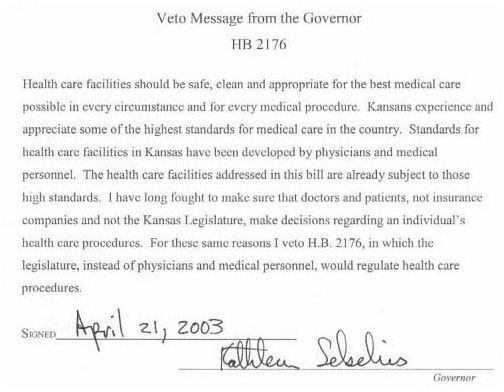
Additionally, Gov. Sebelius spots a solid pro-abortion-rights record dating back to her days in the Kansas House of Representatives when she commented, "I think for me and a lot of other people, there are certain inalienable rights established for a person, but those are not applied in utero." As governor, Sebelius reduced state funding for abortion alternatives, vetoed a bill imposing minimal sanitary standards in abortion clinics, and vetoed a bill (which enjoyed a two-thirds majority in both the Kansas House and Senate) strengthening Kansas's parental notification law. She also vetoed a measure requiring explicit medical reasons for late-term abortions, and vetoed a similar measure making abortion providers file a report on diagnoses necessitating post-viability abortions.
These controversial issues have gone virtually unreported by mainstream media. The NY Times hasn't mentioned Sebelius/Tiller other than an editorial lauding Tiller as a women's rights champion. Associated Press left out Sebelius in its story on Tiller in which it referred to his current trial (opening arguments begin March 23) as a "witch hunt." Mute on the evidence that Tiller had a suspect financial relationship with the "independent" doctor providing second opinions on the validity of Tiller's late term abortions.
The question is whether Sebelius will attempt to distance herself from Tiller. Her own archbishop, Joseph Naumann, opposes her appointment to the HHR position, and has recommended that she not present herself for communion. However, progressive Catholic organizations like Catholics United, defend Sebelius on the basis of declining abortion rates in Kansas; numbers based on unreliable and unclear research according to Dr. New of the University of Alabama.
Is there any chance of Obama distancing himself from Sebelius? No date for her Senate hearings has been set, but Catholic League president Bill Donahue noted upon Sebelius' nomination that almost every Obama appointee is pro-abortion. He suggests that her confirmation would create "a battle between those Catholics who are honestly pro-life, and those who feign a pro-life position while always embracing the likes of Sebelius."
Monday, March 16, 2009

Wednesday, March 11, 2009
Charity: Don't Begin at Home
Even though America is home to over 1.6 million tax-exempt organizations which account for nearly a tenth of the U.S. economy and are primarily funded by wealthy people, Obama's new budget plans on limiting the charitable deduction for the wealthy. The move, which conservatives see as an unprecedented intrusion into the private sector, has discomfited nonprofits across the country. The budget slashes the tax deduction those earning more than $250,000 can take for their charitable giving, dropping it from 33-35% to around 28%.
Obama’s budget director, Peter Orszag, says by limiting itemized deductions, $634 billion would be available to fund health care reform. He argues that although the top income tax deduction for charitable contributions was reduced from 38.6 percent to 35 percent between 2002-2003, individual charitable contributions rose. Yet in a study released earlier this week, the Center on Philanthropy at Indiana University shows that charitable giving is sensitive to the after-tax incomes of high-income households.
The study shows that if the provision had been in place in 2006, charities would have lost almost $4 billion in donations in the intervening period. Independent Sector reports that 89% of American households contribute to charity, with an average contribution of $1,620, which comes out to 3.1% of their income. Additional IRS statistics reveal that the average taxpayer with AGI over $200,000 makes over $20,000 of charitable contributions.
Twenty-four hours after the Presidents FY 2010 budget hit the press, Orzag attempted to reassure ruffled nonprofits. He posted on his Office of Management and Budget blog that the tax change wouldn’t be imposed until 2011, when “we expect the economy to be recovering…from the recession we inherited.”
Conservatives feel that they’re being blamed for the economic mess, and they fear that successful American families will bear the brunt of the government’s implementation of “positive change.” It appears that the proposed limitations on charitable giving is the government’s way of cutting out the individual from social change—getting rid of the Citizen Middleman. Then the government can choose which programs to fund to “help” society. Right now, the American tax payer gets to decide whether their charitable dollars will aid the poor or build new facilities for colleges; depending on their personal information on which would be more effective or necessary. The theory is: People make better choices than bureaucracies and have more freedom to be generous.
Perhaps the connection problem between the Obama administration and charitable giving is that there isn’t one.
During last year’s campaign, Bill Burton, a campaign spokesman, defended the Obamas scanty charitable donations, saying they gave as much as they could afford. Barack and Michelle gave less than one percent of their $1.2 million income from 2000 to 2004. The Biden’s tax returns show that the Bidens have been amazingly tight-fisted as well. Despite income ranging from $210,432 - $321,379 over a ten-year period, the Bidens have given only $120 - $995 per year to charity, which amounts to 0.06% - 0.31% of their income. Compare that to John McCain, whose tax returns show that he gave 27.3% - 28.6% of his income to charity in 2006-2007. Not that Biden’s charitable contributions haven’t increased. They suddenly spiked in 2007 —which would be just about the time he decided that the White House was within reach. Unfortunately, Biden must have forgotten all the flak Vice President Al Gore took when America found out about his whopping $353 in charitable contributions one year.
Although President Obama is counting on the charitable tax change provision to raise $179.8 billion over 10 years for government spending, Roberton Williams, senior fellow at the Tax Policy Center, predicts organizations dependent on philanthropic giving will have to pay the price.
Obama’s budget director, Peter Orszag, says by limiting itemized deductions, $634 billion would be available to fund health care reform. He argues that although the top income tax deduction for charitable contributions was reduced from 38.6 percent to 35 percent between 2002-2003, individual charitable contributions rose. Yet in a study released earlier this week, the Center on Philanthropy at Indiana University shows that charitable giving is sensitive to the after-tax incomes of high-income households.
The study shows that if the provision had been in place in 2006, charities would have lost almost $4 billion in donations in the intervening period. Independent Sector reports that 89% of American households contribute to charity, with an average contribution of $1,620, which comes out to 3.1% of their income. Additional IRS statistics reveal that the average taxpayer with AGI over $200,000 makes over $20,000 of charitable contributions.
Twenty-four hours after the Presidents FY 2010 budget hit the press, Orzag attempted to reassure ruffled nonprofits. He posted on his Office of Management and Budget blog that the tax change wouldn’t be imposed until 2011, when “we expect the economy to be recovering…from the recession we inherited.”
Conservatives feel that they’re being blamed for the economic mess, and they fear that successful American families will bear the brunt of the government’s implementation of “positive change.” It appears that the proposed limitations on charitable giving is the government’s way of cutting out the individual from social change—getting rid of the Citizen Middleman. Then the government can choose which programs to fund to “help” society. Right now, the American tax payer gets to decide whether their charitable dollars will aid the poor or build new facilities for colleges; depending on their personal information on which would be more effective or necessary. The theory is: People make better choices than bureaucracies and have more freedom to be generous.
Perhaps the connection problem between the Obama administration and charitable giving is that there isn’t one.
During last year’s campaign, Bill Burton, a campaign spokesman, defended the Obamas scanty charitable donations, saying they gave as much as they could afford. Barack and Michelle gave less than one percent of their $1.2 million income from 2000 to 2004. The Biden’s tax returns show that the Bidens have been amazingly tight-fisted as well. Despite income ranging from $210,432 - $321,379 over a ten-year period, the Bidens have given only $120 - $995 per year to charity, which amounts to 0.06% - 0.31% of their income. Compare that to John McCain, whose tax returns show that he gave 27.3% - 28.6% of his income to charity in 2006-2007. Not that Biden’s charitable contributions haven’t increased. They suddenly spiked in 2007 —which would be just about the time he decided that the White House was within reach. Unfortunately, Biden must have forgotten all the flak Vice President Al Gore took when America found out about his whopping $353 in charitable contributions one year.
Although President Obama is counting on the charitable tax change provision to raise $179.8 billion over 10 years for government spending, Roberton Williams, senior fellow at the Tax Policy Center, predicts organizations dependent on philanthropic giving will have to pay the price.
Sunday, March 1, 2009
The U.S. shares more than a 1952-mile border with Mexico
Not long after the U.S. National Drug Intelligence Center issued its annual drug-threat assessment, in which it warned that “Mexican drug trafficking organizations represent the greatest organized crime threat to the United States,” Justice Department officials arrested 755 members of the powerful and feared Sinaloa Cartel. Agents working on the DEA’s 21-month crackdown (named “Operation Xcellerator”) caught only 20 of the drug operators on Mexican soil. They pulled in the remaining 735 from California, Minnesota and Maryland, and other cities and towns across the U.S. While the arrests are celebrated as a victory against drug cartels, they also highlight U.S. involvement in Mexico’s escalating drug problem and its economic factors.
Mexico’s economy is the 14th-largest in the world and Mexico is the U.S.’s second-largest export market. Since January, the Mexican currency has fallen around 5 percent against the U.S dollar, coming on the heels of a 21-percent slump in 2008. Mexico's central bank reluctantly intervened last October when the peso hit its lowest slump since 1993, but the year outlook is pretty bleak.
Petroleos Mexicanos, the state-owned oil company, said that crude output fell 9.2 percent in 2008, the largest percentage decline since World War II, as production at its biggest field dropped. PeMex provides about one-third of Mexico's federal government revenue. Mexican Finance Minister Augustin Carstens said economic growth in the fourth quarter of last year was “close to zero,” and that the government forecasts no growth this year.
Economic instability foments unrest. Mix in rampant drug activity, violence, and corruption in the government, and you have the recipe for Mexico 2009. Forbes reported both Pakistan and Mexico as nations facing a potential “failed state,” much to the outrage of Mexican President Felipe Calderón.
Calderón vows that before his term ends in 2012 he will have defeated the cartels, but the rising body count is alarming. In 2009 narcotraficantes claimed over 6,000 lives, and that number is expected to be higher this year. On a single day this month, a drug gang executed six members of a rival gang on the side of PanAmerican highway across the border from El Paso, Texas. The ensuing gunfights left 21 dead. Gruesome murders and decapitations have become familiar drug-zone terror-tactics. The cartels are trying to scare away law enforcement, and Felipe González González thinks they are doing a good job.
González, president of the Senate public security commission and former governor of the central state of Aguascalientes, sees the inability of government troops to protect its citizens from drug-gangs as a grave problem. González told Forbes “It has been a fierce bloodbath…we have more dead than you have in Iraq.”
President Obama, who faced criticism for not visiting Mexico upon taking office, has yet to address the situation. In a February 2008 op-ed published while he was Senator, Obama said that as president he would repair strained relations through diplomacy and partnership. “Mr. Bush took office vowing to make the Americas a top priority. But over the last seven years, the administration's approach to this issue has been clumsy, disinterested and, above all, distracted by the war in Iraq. Indeed, relations have not fully recovered since Mexico refused to fall in line with President Bush's rush to war.”
Mexico’s economy is the 14th-largest in the world and Mexico is the U.S.’s second-largest export market. Since January, the Mexican currency has fallen around 5 percent against the U.S dollar, coming on the heels of a 21-percent slump in 2008. Mexico's central bank reluctantly intervened last October when the peso hit its lowest slump since 1993, but the year outlook is pretty bleak.
Petroleos Mexicanos, the state-owned oil company, said that crude output fell 9.2 percent in 2008, the largest percentage decline since World War II, as production at its biggest field dropped. PeMex provides about one-third of Mexico's federal government revenue. Mexican Finance Minister Augustin Carstens said economic growth in the fourth quarter of last year was “close to zero,” and that the government forecasts no growth this year.
Economic instability foments unrest. Mix in rampant drug activity, violence, and corruption in the government, and you have the recipe for Mexico 2009. Forbes reported both Pakistan and Mexico as nations facing a potential “failed state,” much to the outrage of Mexican President Felipe Calderón.
Calderón vows that before his term ends in 2012 he will have defeated the cartels, but the rising body count is alarming. In 2009 narcotraficantes claimed over 6,000 lives, and that number is expected to be higher this year. On a single day this month, a drug gang executed six members of a rival gang on the side of PanAmerican highway across the border from El Paso, Texas. The ensuing gunfights left 21 dead. Gruesome murders and decapitations have become familiar drug-zone terror-tactics. The cartels are trying to scare away law enforcement, and Felipe González González thinks they are doing a good job.
González, president of the Senate public security commission and former governor of the central state of Aguascalientes, sees the inability of government troops to protect its citizens from drug-gangs as a grave problem. González told Forbes “It has been a fierce bloodbath…we have more dead than you have in Iraq.”
President Obama, who faced criticism for not visiting Mexico upon taking office, has yet to address the situation. In a February 2008 op-ed published while he was Senator, Obama said that as president he would repair strained relations through diplomacy and partnership. “Mr. Bush took office vowing to make the Americas a top priority. But over the last seven years, the administration's approach to this issue has been clumsy, disinterested and, above all, distracted by the war in Iraq. Indeed, relations have not fully recovered since Mexico refused to fall in line with President Bush's rush to war.”
Subscribe to:
Comments (Atom)